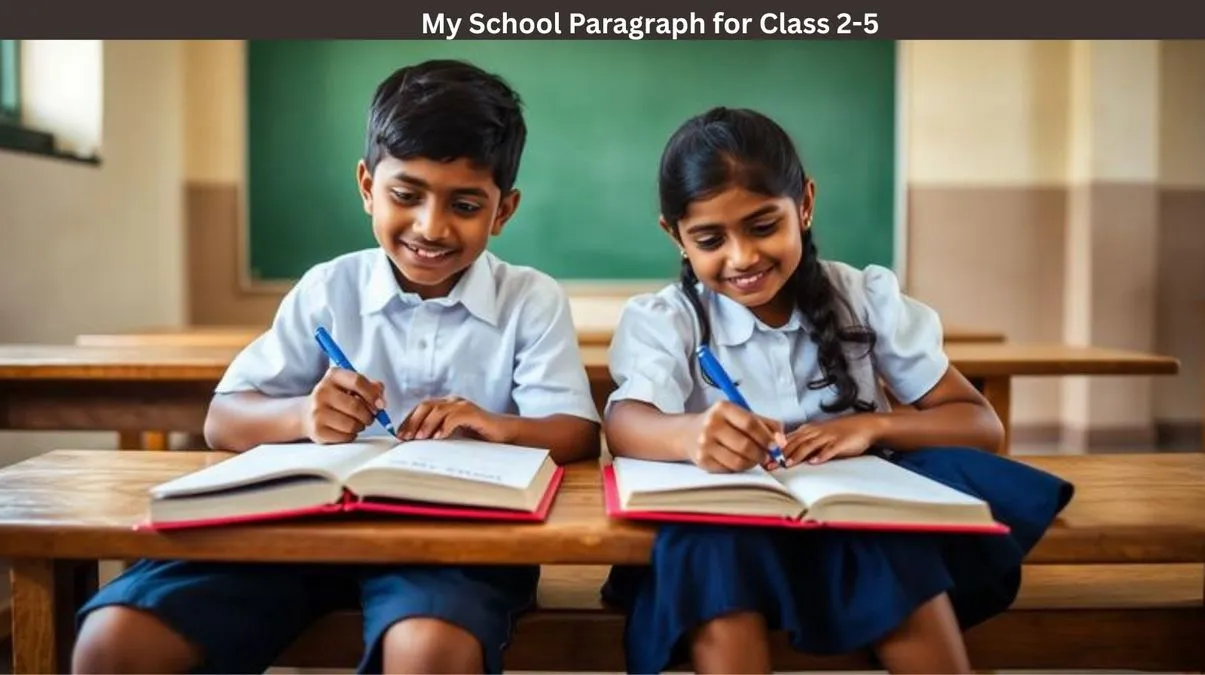
My School paragraph sounds simple for the students from Class 2 to Class 5, but most of the kids freeze when the teacher asks them to “write 10 lines.” This topic is very real and close to students, but sometimes issues are not noticed until they are asked to write a few lines on this.
This guide gives you ready-to-use paragraphs for students, plus a simple formula so that a child can write their own version too – not just copy from any digital platform or using any AI.
This article will cover short 5-line examples for the younger kids, and longer 10-line paragraphs for the students of Class 4-5. The real facts about Indian schools make this article trustworthy, not just generic examples.
What Should I Write About My School?
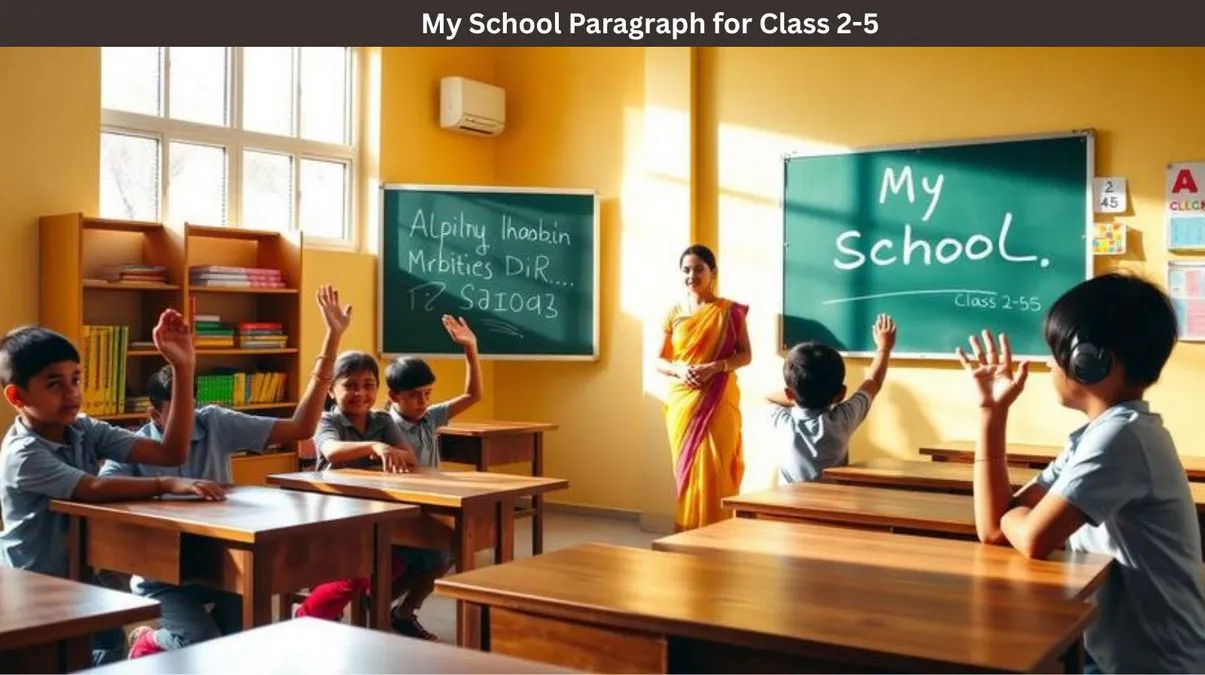
Write about four to five things: your school name and type, how it looks, who teaches you, what you enjoy doing there, and what you learn there. That’s it – no fancy vocabulary needed.
A good school paragraph usually follows this order:
- School name, location, and type (government/private, co-ed or not)
- Principal Office and teachers room
- Buildings, classrooms, playground, library
- Teachers and how they help you learn
- Your favorite subject and activity
- Friends at school
Younger kids in Class 1-2 can stick to 3-4 of these points that will take 4-5 lines to cover. Little older kids studying in Class 4-5 can add small details like school timings, uniform color, or annual events like Independence Day, Republic Day, Annual Sports Day, and Annual Meet.
Quick Tip for Parents
While writing this paragraph, if your child is stuck, then ask him one simple question: “ What do you like most about your school?”Their answer usually\ becomes the strongest, most natural-sounding line in the whole paragraph – because it is absolutely genuine, because it is their own words, not copied.
My School Paragraph for Class 2 (5 Lines)
For Class 1-2, keep sentences short, simple, and in the present tense. Here’s a sample:
- My school’s name is [School Name].
- It is a big and beautiful building with many classrooms.
- I study in Class 2.
- My class teacher is friendly and teaches new things every day.
- I like to play in the playground with my friends during short breaks.
This works because each line reflects one single idea. Kids this age struggle with joining sentences, so five short lines with separate thoughts become better than joining two long lines, which might get complicated.
Why 5 Lines Is the Right Length for Class 1-2
Young kids are in a learning phase of building sentences, writing their thoughts, and making spelling mistakes. So, a short five lines are enough to practice without overwhelming them.
Teachers at this stage usually check for:
- Handwriting and spelling errors
- Correct use of capital letters and full stops
- Simple and short sentence
- Simple subject-verb agreement (“I like”, not “I likes”)
- At least one personal detail (favorite friend, subject, or activity)
My School Paragraph for Class 3-5 (10 Lines)
For Class 3 and above, the concept of writing a paragraph gets a little longer than for Classes 1-2. This includes more description and personal opinion. Here is a 10-line example:
- My school is called [School Name], and it is located in [City/Area].
- It is one of the best schools in our area, with big classrooms, computer labs, a large playground, a big parking area, and a well-stocked library.
- I study in Class [3/4/5], and my class teacher’s name is [Teacher’s Name].
- Our school starts at 8:00 AM and ends at 2:00 PM, from Monday to Saturday.
- We wear a neat bi-colored uniform every day, and on Friday, we have a games period.
- My favorite subject is [Subject Name] because [reason].
- Our school celebrates events like Independence Day, Sports Day, and Annual Day with great enthusiasm.
- The teachers are always kind and encourage us to ask questions.
- I have four friends, and with them I play on the ground during a short break.
- I feel proud and happy to be a student at my school.
Notice each line, how each idea or new fact is added with a value – school timing, subjects, teachers, uniforms, events – rather than repeating the same idea in different words.
How Is Class 5 Different From Class 3?
The teachers expect their students to write with a mature opinion, like “ I feel proud to be a student of my school,” which reflects the emotional angle of a student. As for expectation, students of Class 5 should not forget to add their personal opinion, which will carry the value of the paragraph. In the higher primary classes, the examiner will hunt for these personal sentimental touches.
How Do I Write a Paragraph About My School? (Step-by-Step)
Break it down into four simple steps: note down or list facts, order them logically, add one personal touch, check missing facts, check spelling, and full stops. This is the basic syntax of paragraph writing. This method works for any class level.
- Note down facts – jot down 5-6 facts about your school (name, teachers, playground, subjects, events).
- Arrange in Order – start with name or location, then move to specify classroom and teachers, end with a personal touch like “ what you like”
- Add One Feeling Word – “happy,” “proud,” “excited” – this makes the paragraph more realistic and personal, not robotic or copied.
- Missing Facts – read it silently so that you can fix the unwanted or missing part
- Read Aloud and Final Review – this catches missing full stops and repeated words faster than silent reading.
Common Mistakes Kids Make
A paragraph loses its marks not because of its idea, but due to word repetition, missing capital letters, or mixing tenses( starting with a present tense and later drifting into past tense midway). A quick read-aloud will help to find and fix the error.
Why Does Learning to Write About “My School” Actually Matter?
My school paragraph is not just a task to perform in exams and get good marks. This piece of writing generates the real observation and descriptive skills that carry into future essay formats.
This is a topic where students get to interact with the real world and their own observations. Young kids and older students can easily explore their thoughts and ideas and put real emotion to describe a man-made building, which they call a school.
According to The Times of India, an Indian News Report from Lucknow published that nearly 8.7 lakhs students get admitted in state-run schools across Uttar Pradesh under the scheme “School Chalyo Abhiyan” for the 2026-27 academic session.
So, when a student of Class 3 writes “my school paragraph,” they’re describing a system that generates a huge amount of content with various angles. The teachers guide them to understand the power of thinking and the observation about the real world around them, because school is the second home for the students.
Does the Length of the Paragraph Matter for Marks?
Yes, but the word length is set according to the class level- writing more than asked does not earn extra marks and can actually cost time in an exam.
Teachers typically expect:
- Class 1-2: 4-5 lines
- Class 3-4: 6-8 lines
- Class 5: 8-10 lines
Going beyond this range will not be treated as a penalty, but it will erode away your time in the exam hall.
My School Paragraph Examples by Format
Different classes need different formats – here is a side-by-side view so parents can pick the right length instantly.
5 Lines (Class 1-2): Focus on name, building, teacher, one activity, and one friend.
10 Lines (Class 3-5): Add school timing, uniform, subjects, events, and a personal reflection line.
Both these given formats can describe the exact same school – the difference is purely in how details get included and how the sentences are connected.
You may also feel like to read more:-
My School Essay – Easy & Simple Essay for Classes 1 to 8
My Pet Paragraph for Class 1 to 8
My Father Paragraph for Class 1 to 5
Frequently Asked Questions
Q1. What should I write in my school paragraph if I'm in Class 2?
For Class 2, keep it around 5 short lines: school name, building, class teacher, one subject you like, and an activity you do with friends during break.
Q2. How many lines should a Class 5 school paragraph have?
A student should aim for around 8-10 lines, which includes: one personal opinion line at the end, and how the school makes you feel.
Q3. Can I use the same paragraph for Class 3 and Class 4?
Mostly yes, but Class 4 paragraphs usually need a little more detail - like school timings or a specific teacher’s name whom you like most and why - compared to Class 3.
Q4. What is the easiest way to remember what to write?
Use this simple order: name of the school and location, describe buildings and classrooms, write about your favorite teachers, subjects you like, activities you do, and how you feel about school. These steps rarely fail.
Q5. Should the paragraph be written in present or past tense?
Since you are describing your school, always use the present tense. Most of the students get confused in the segment. You are describing your school according to its current situation, not something that happened in the past.
Q6. Do I need to mention my school's uniform or timings?
It is absolutely optional for the students of Class 1-3, but for higher primary sections adding more details is a plus as it shows the personal observation skills beyond the basics.
Final Thoughts
A “My School” paragraph doesn’t need big words – it needs honesty, an ordered observation that you feel when you are in the school.
Whether your child is in Class 2 writing five lines or Class 5 writing ten, the same simple formula works: name and place, description, teachers, activities, and one personal feeling at the end is enough.
Encourage your child to personalize at least one line with their own opinion. That specific line that the teacher will remember for a long time, and this line makes the paragraph feel as if it’s actually about their school, not copied.
📖 Join 500+ parents & students
Daily essays, worksheets, and writing tips on Telegram.

I am not a professional writer. I do not have a degree in English literature. What I have is 10 years of watching children learn, a son in Class 4 who still asks me to help with his writing, and a genuine belief that every child has something worth saying- they just need the right guide.



2 thoughts on “My School Paragraph for Class 2-5 (5 & 10 Lines)”