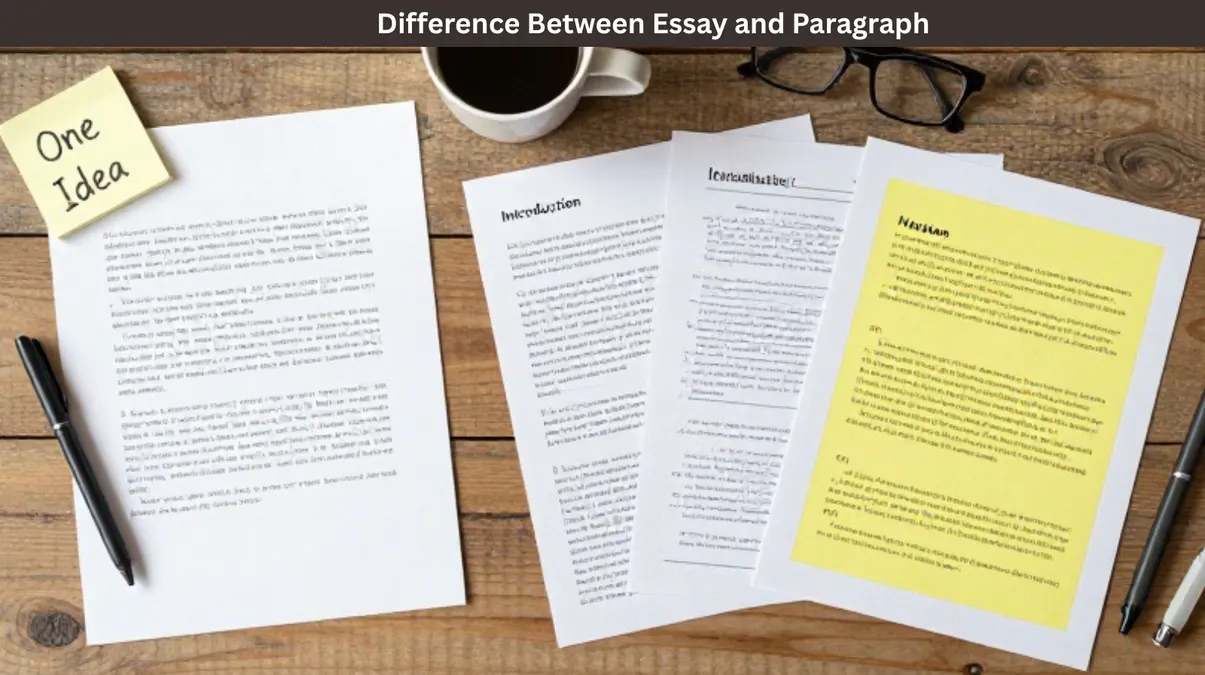
Difference between essay and paragraph is that an essay is a slice of writing covering a single topic. An essay is a detailed account of a single idea from a different angle of projection. On the other hand, a paragraph covers the same idea or topic within a single block.
An essay sticks with a single point, but there are a lot of angles or discussion to deliver in several blocks of paragraphs. A paragraph is just a piece of writing that covers the intro, body, and conclusion in a single block.
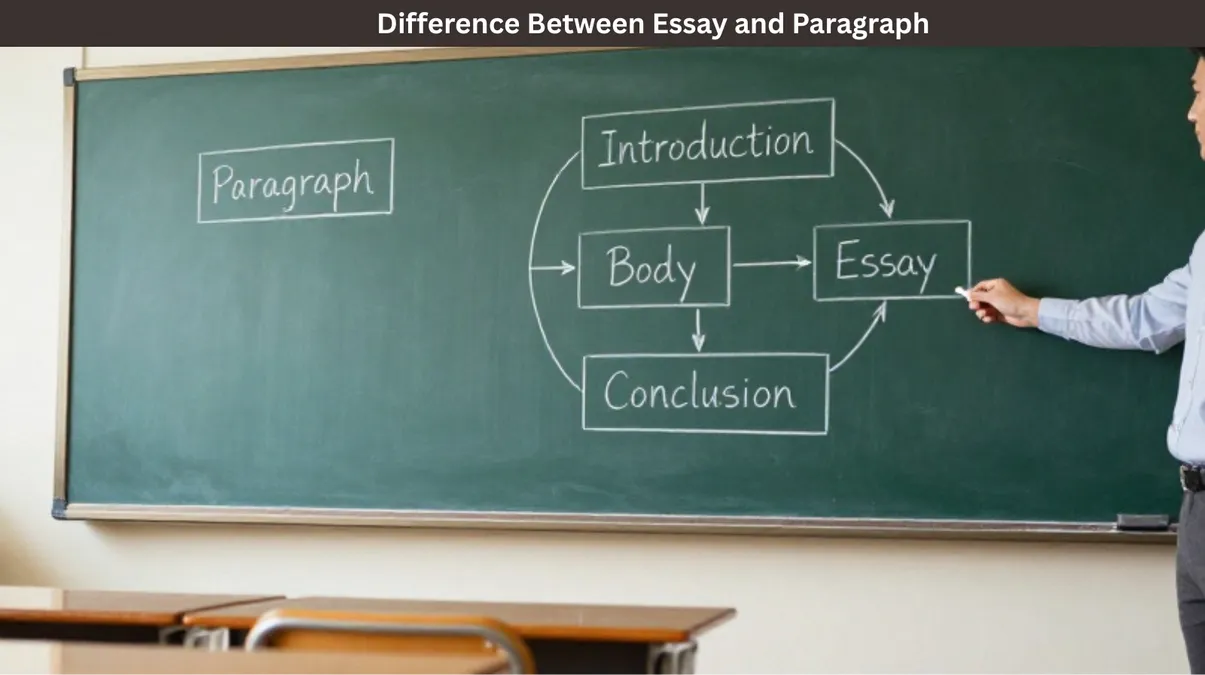
Think of it like this: a paragraph is a single room in a house, and an essay is the whole house where walls connect these rooms, and the front is the door, which we call the introduction; the whole house, stairs, and other parts are the body; and the back door is the conclusion.
If you are a student of primary or higher primary and preparing for the school English exam, understanding matters most. Let’s break it down clearly.
What Is a Paragraph?
A paragraph is a group of sentences that revolve around a single idea. It usually has a main topic sentence and a few supporting sentences related to that idea, with a closing line.
Understanding the concept of creating blocks in almost every writing pattern will help readers understand better, and the writer will grow mature by following the block pattern in every writing section, like essays, articles, letters, and applications.
A typical paragraph is short – usually 100 to 200 words- though they fulfill various purposes. It does not need any introduction or conclusion in separate blocks. The full piece of writing section will make you understand every single section.
Example of a Paragraph
“Reading daily improves vocabulary and focus. Students who read for at least 15 minutes daily could easily write, adding the sentences with proper purpose. The students will score high comparative to the other students who do not practice. Reading also reduces stress by lowering heart rate within minutes. For these reasons, many school authorities are introducing this daily reading practice in their curriculum.”
Notice: one idea (benefits of reading), a few supporting points, done.
What Is an Essay?
An essay is a well-structured piece of writing that explores a topic in depth, using multiple block paragraphs to explain the main topic from different angles. It has three layers of structure: an introduction, a body that includes a few paragraphs for explanation or support, and finally a conclusion that sticks to the topic idea.
An essay= an introduction+ a body( paragraph+ a paragraph+ a paragraph) + a conclusion
So, each body paragraph in an essay covers different sub-points, but all the points focus on a single topic.
Essays are longer – typically 500 words and up, depending on the academic grade. Usually, students in Class 5 and above follow this pattern to score high in exams.
Example of an Essay Structure
- Introduction: Discuss topic points with an opening sentence.
- Body Paragraph 1: First supporting point with evidence
- Body Paragraph 2: Second supporting point with evidence
- Body Paragraph 3: Third supporting point or counter the argument
- Conclusion: Summarize + closing thought
Difference Between Essay and Paragraph: Quick Comparison
| Feature | Paragraph | Essay |
| Length | Short (100–200 words) | Long (500+ words) |
| Structure | One idea, no intro/conclusion needed | Intro, body, conclusion |
| Purpose | Develops a single point | Explores a topic from multiple angles |
| Number of ideas | One | Multiple, connected sub-ideas |
| Use case | Part of a larger document | Standalone piece of writing |
This table alone answers most searches for “difference between essay and paragraph writing” – but let’s go deeper so that readers, writers, and learners must not miss anything.
Essay Vs Paragraph: The difference (Side-by-Side)
Paragraph example (topic: pollution): “Air pollution in metropolitan cities are rising compared to the rural areas. The pollution is rising due to factories’ waste and vehicle emission. This has led to a sharp increase in heart problems and respiratory illness among all ages. Only green support from the people can save the earth and mankind.”
Essay example (same topic, expanded): An essay on pollution will start with an introduction, defining the cause of pollution and its crisis. Then write a dedicated separate block of paragraphs defining the cause vehicle, industry), effect ( health, environment), and the solution approach- before a closing statement that concludes.
This side-by-side view makes the difference between essay and paragraph writing easy to visualize: same topic, very different depth and structure.
Difference Between Paragraph and Passage
It is rather difficult to distinguish between a paragraph and a passage, because they look more or less the same. But a passage usually refers to an extract from a larger text; it is like a paragraph that is taken from an article or textbook.
A paragraph is a unit of writing you create. A passage is often a unit of text that you analyze after reading an article, which may contain a number of paragraphs.
In short: every paragraph can be part of a passage, but not every passage is just one paragraph.
Difference Between Essay and Composition
From a modern point of view, “essay” and “composition” are nearly the same thing- a structured piece of writing on a single main topic.
Composition is a frequent term we use in school-level textbooks, while an essay is a more common global term, which is generally used in higher school grades.
So the difference is mostly generational and regional, not structural.
Why This Difference Matters for Students and Writers
Writing a “one-paragraph essay” (a common student mistake) usually results in lower scores because it lacks focus and depth. On the flip side, breaking an essay into many short paragraphs is not a smart move, because it will hurt your score chart.
Getting the balance right – one idea per paragraph, complete structure, proper transitions (e.g., ” As a result”), and meaningful related sentences – is what examiners and readers actually reward.
How to Convert a Paragraph Into a Full Essay
- Identify the core idea in your paragraph – this becomes your gem.
- Break supporting sentences into separate points – each block becomes its own body paragraph.
- Add an introduction that gives context and states the idea.
- Add a conclusion that summarizes and gives dimension for your argument.
- Insert transitions (“However,” “In addition,” “As a result”) between paragraphs so the essay flows.
This is the practical skill that will turn your short-answer writing into exam-ready essays.
This is for you if you feel OK to read more:-
How to Write a Paragraph Step by Step: A Complete Guide
Struggling with Essay Writing?
My Father Paragraph for Class 1 to 5
FAQ Section
Q1: What is the main difference between essay and paragraph?
A paragraph covers a single idea in a short, structured block. An essay covers the full topic, connecting many small paragraphs, complete with an introduction and conclusion.
Q2: How many paragraphs are in an essay?
Most standard essays have at least three paragraphs - one introduction, one or more paragraphs as the body, and one conclusion. The length of the essays depends on the grade level.
Q3: Can a paragraph be considered a mini essay?
Not technically. A paragraph lacks the introduction-body-conclusion structure that defines an essay; even strong written content disqualifies it.
Q4: What is the difference between essay and paragraph writing style?
Paragraph writing sticks to one point with minimal structure. Essay writing requires planning, structure, and transitions.
Q5: What's the difference between an essay and a passage?
A passage is often an extract used for reading or analysis, while an essay is a complete form of writing built from scratch, with specific thoughts.
Final Takeaway
The difference between an essay and a paragraph comes down to the message to deliver. A paragraph is written on one idea within a structured block. On the other hand, an essay covers many ideas, giving support to a single topic with a beginning, middle, and end. Essays are more organized than a paragraph.
Once you understand the difference, writing becomes less confusing- whether you write for school, competition, or for your blog. Start your training on ” how to write strong paragraphs,” and then do well-structured essays. The improvement will become stronger day by day.
📖 Join 500+ parents & students
Daily essays, worksheets, and writing tips on Telegram.

I am not a professional writer. I do not have a degree in English literature. What I have is 10 years of watching children learn, a son in Class 4 who still asks me to help with his writing, and a genuine belief that every child has something worth saying- they just need the right guide.