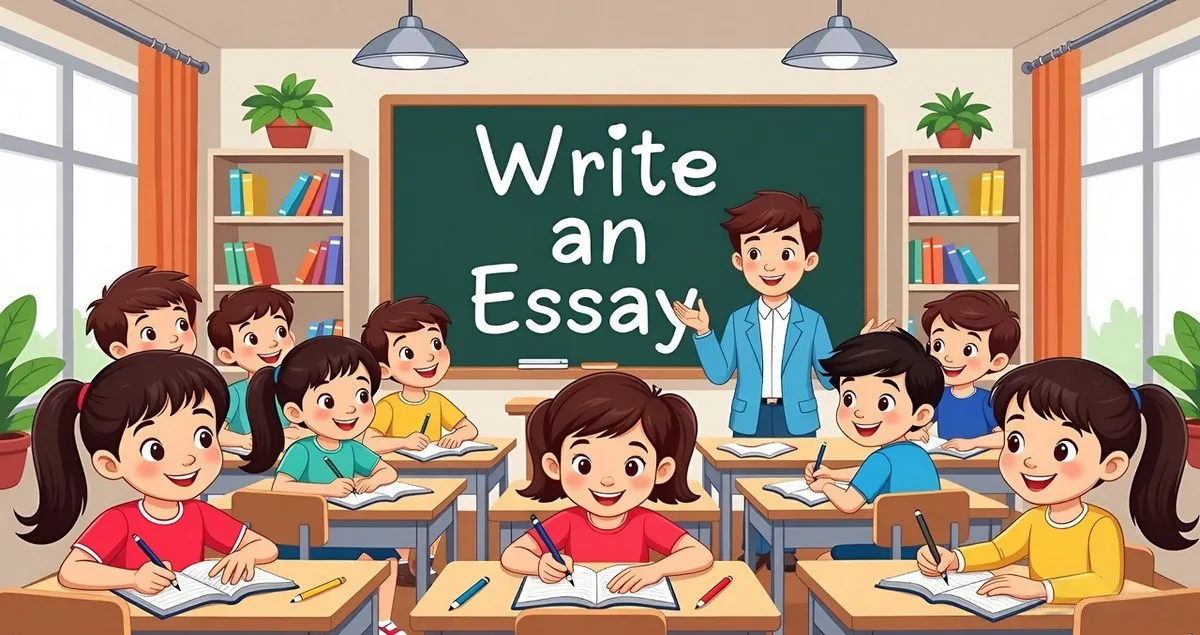
Writing essays in school is a regular task every student faces. Teachers have a good habit of saying, “Open your copy and write an essay.” This becomes almost a weekly punch for the students.
Some students stare at the copy, some are annoyed, some get blank. A few actually enjoy it. But whether students like it or not, essay writing is an essential part of classwork, homework, and exams from Class 1 through Class 8 and above. It is not going away – there are good reasons for that.
What Is an Essay, Exactly?
An essay is a short piece of writing on a single topic, where students can write their own words.
It is not a list. It does not need any bullet points. It’s connected sentences that build an idea from start to end. A student might write about their family, a rainy day, or a national festival. The topic changes. But the goal stays the same: saying something clearly, in order, in your own voice.
Mostly, school essays follow three parts: an introduction, a body, and a conclusion. This structure teaches students to think in a sequence – what comes first, what to support it, and how to wrap it up.

Essay: A Clear Definition
An essay is a short piece of writing where students get the freedom to share their thoughts and ideas freely on a single topic in simple and clear words.
Students may write essays about their family, their best friend, a rainy day, festivals, or some other topic. When students write essays in school, they practice writing their thoughts in an organized form.
Why Do Teachers Ask Students to Write Essays?
Essay writing is a good way to build several skills at once, which is why teachers often give tasks to their students.
Here’s what regular practice of writing essay will help students:
- Sentence construction – students learn how to use words to form a constructive sentence
- Vocabulary – writing demands the right words to form a sensible sentence
- Handwriting – especially in primary classes, essay writing improves handwriting
- Topic understanding – writing about something will improve thinking
- Exam readiness – most Indian school exams include at least one essay question.
Most students focus on marks. That’s fine.The deeper impact is a student who can explain things clearly – in exams, in college, and in their professional life.
How Essay Writing Actually Works in a Classroom
A typical essay session looks like this: the teacher writes a topic on the blackboard, students open their notebooks, and everyone writes for 15–30 minutes.
The teacher writes a topic on the blackboard, students are told to open their notebooks, and everyone starts writing within a scheduled time.
The teacher walks around the classroom, usually looking at the student’s writing in their notebooks. This is a regular observation done by the teacher to check the student’s progress, sometimes reminds them of their spelling errors, and sometimes warns students to avoid peeking into others’ notebooks.
In the exam conditions, there is a time limit too – usually 10 to 15 minutes for a 150-200-word essay at the primary level.
This time, teachers intentionally force students to write about the topic. It trains them to understand the topic quickly, think and write instantly, select words, and complete sentences with a focused mindset. That’s the same skill tested on every exam they take.
In exams, teachers check essays for:
- Whether the student understood the topic
- Sentence clarity and grammatical errors
- Correct spelling
- Net and tidy handwriting
- The concept of staying with the topic from start to end
A student of Class 4 writing “My Mother” is learning to build a constructive sentence around a family topic. A student from Class 7 writing “The Importance of Tree” is learning to establish a point around the topic with reasons and examples. It is the same format, with a well-grounded demand.
Why the Topic Type Matters More Than Most People Realize
Not every essay topic teaches the same skill – and this is something that teachers don’t explain to the students or parents.
There are three broad types of essay topics:
Personal topics like “My School,” and “My Best Friend” ask students to describe something they already know. These types of topics give fluency and grow confidence. Students who usually practice these topics can easily perform. But when the topic shifts, they get frozen by the unfamiliar temperament of writing.
Abstract topics like “Honesty,” “Discipline,” and “Hard Work” ask students to form an opinion and support the points they write. This is harder. Class 8 students who have only written personal essays will struggle here because opinion-based writing has different requirements and thought processes.
Current affairs topics like “Save the Environment,” and “Digital India,” the students need real knowledge to write. If you only support building the piece of writing with your grammar efficiency, it will not be enough because only the subjects matter.
Solid Tips:– Students who practice all three types across the year are far better prepared for exams than students who only practice one. So, practice on various topics matters more than writing in volume.
What Happens Before Essays: Paragraph Writing
Most school-level syllabi introduce paragraph writing before essays, and for good reason.
A paragraph is focused on one single idea, written within 4-6 sentences. It teaches students to stay on a single point without drifting. Once the student learns to write a paragraph, they can easily understand the mechanism of the essay and will be able to create a better essay.
So, before jumping into the essay, a student must learn to write a paragraph.
Common Mistakes Students Make in Essays (And Why They Keep Repeating)
Most essay mistakes fall under a small pattern:
- Starting to write before, understanding what the topic actually wants
- Repetition of the same words or the same sentence structure
- Spelling the same word wrong throughout (and not noticing)
- Writing an introduction that takes half of the essay
- Going off-topic after the first paragraph
- Ending with certain points that are not connected to the topic
During notebook correction, teachers point out those mistakes. But the problem stays with the students, because they look at the grade, not the correction.
The fix is simple but rarely taught: before submitting, go through the writing.
Ask yourself:
1) Does the first sentence make sense in what you want to deliver?”
2) Is each paragraph connected to the one you wrote?
3) Does the conclusion say something new, or repeat the introduction, or does the conclusion carry the value of the beginning sentiments?
Students who do this – even quickly – are capable of reviewing their own mistakes before the teacher does.
Why Daily Practice Without Feedback Stops Working
Teachers and parents often say “practice daily” – and that’s true, up to a point.
Students who practice daily may even fail to perform. They should monitor their upgrade in performance and understanding.
3 essays with review and correction are not enough. Students should discuss those improved versions that can beat 10 essays with a tick and a grade.
If a student’s writing looks clear but feels empty, with no grammar errors, no spelling mistakes, and has no worth of reading, then they are in this pattern. The fix is a slow process, write less and spend more time with the essay, and understand what exactly the essay wants.
The Skill Most Students Never Develop: Reading Their Own Writing
There’s a real difference between proofreading and revision.
| Proofreading | Revision |
| Proofreading is checking for spelling and punctuation errors. Every teacher teaches this. | Revision is asking: does this say what I meant? Almost no one teaches this in school. |
Students who mastered the art of revision – even slowly- improve faster than students who write more.
A simple 3-question check works for any essay:
- Did I answer what was actually asked, or what I assumed was asked?
- Does each paragraph connect to the one before it?
- Does my conclusion say something, or repeat the introduction in different words?
Running these 3 questions as your checklist will take 2 minutes. It catches most of the mistakes that cost marks.
You can read more topics:-
Struggling with Essay Writing? Learn How to Start and End It Perfectly
Conclusion: What Essay Writing Actually Builds
Essays are not just a simple piece of writing, demanded by the teachers. This is a thinking exercise with a structure or pattern.
Every time a student writes an essay – even short or imperfect – they practice taking scattered thoughts and putting them in order. That skill one learns can be implemented in other subjects that matter most. Students get well prepared to take any competitions, exams, or any other situations in adult life where explanation is needed under time pressure.
The students who get good at essays aren’t the ones who write the most. They’re the ones who pay attention to what their writing actually says.
Frequently Asked Questions
1) Why do teachers give essay writing in school?
Writing an essay in school trains students in how to construct sentences, the ability to organize ideas, and writing fluency. It prepares the students for an exam format where written structures carry heavy marks.
2) What is the right length for a school essay?
At the primary level (Class 1–5), 80–150 words is standard. At secondary school level (Class 6–8), 150–250 words. Quality matters most rather than length.
3) How can a student improve essay writing fast?
Write one essay. Read aloud as if you are reading it for the first time. Do this practice 2-3 times a week for a month. You will notice the improvement slowly.
4) Does essay writing help in subjects other than English?
Yes. Clear and structured writing improves answer quality in Science, Social Studies, and History, where explanation and reasoning carry marks.
5) At what age should kids start writing essays?
Most schools introduce basic paragraph writing around Class 2 ( age 7-8) and short essays by Class 3 or 4. Formal essay structure - introduction, body, and conclusion is usually taught from Class 5 onwards.
📖 Join 500+ parents & students
Daily essays, worksheets, and writing tips on Telegram.
🔗 Join Telegram Channel
I am not a professional writer. I do not have a degree in English literature. What I have is 10 years of watching children learn, a son in Class 4 who still asks me to help with his writing, and a genuine belief that every child has something worth saying- they just need the right guide.
I face this situations. The points are clear.