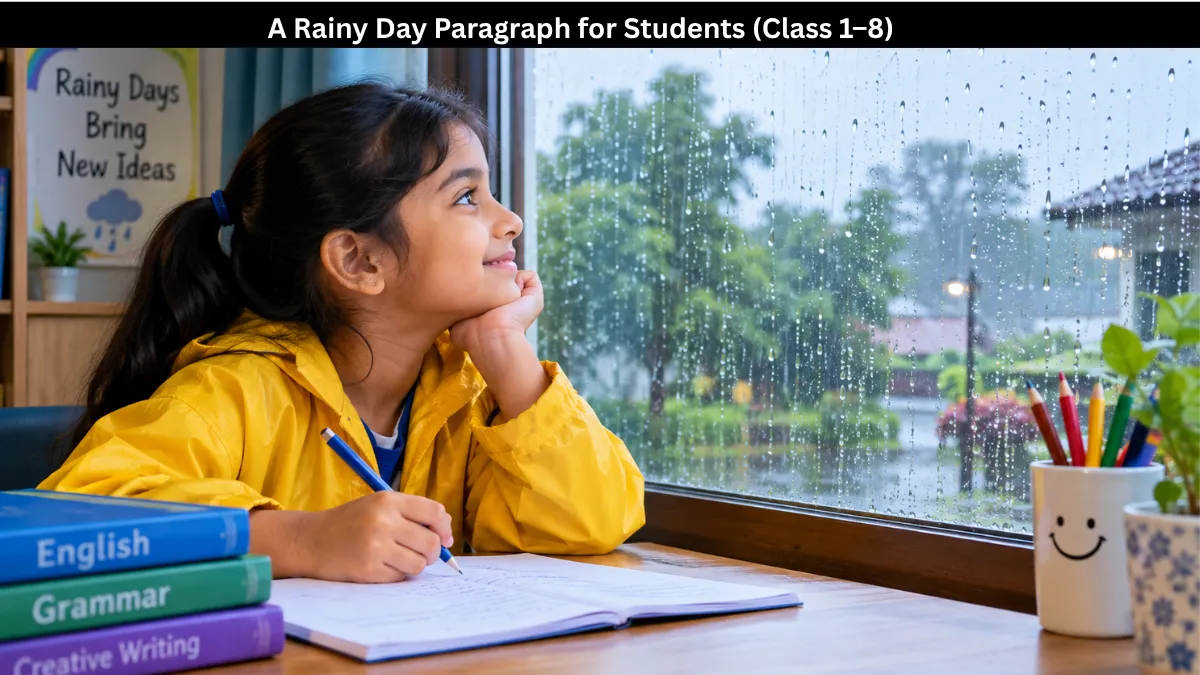
Rain changes everything on a school day – the tip-tap sound, the smell, the mood in the classroom. If you are a student, parent, or a teacher looking for a student-friendly paragraph on “ A Rainy Day”, you are in the right place. Below you will find ready-to-use paragraphs for Class 1-2, Class 3-5, and Class 6-8, along with a simple roadmap to help you write your own.
What Is a Rainy Day Paragraph?
A rainy day paragraph is a short paragraph – usually 80-150 words- where students are free to describe the sights, sounds, and feelings of a rainy day. Younger students from Class 1-2 can use very short sentences, while older students from Class 6 to 8 need to add reflection and vocabulary depth.
What You’ll Learn From This Guide
- Rainy day paragraphs are a very common English writing topic for students in Classes 1-8 in India, Bangladesh, and Pakistan.
- Younger students will go for short and simple paragraphs, and older students will write a richer piece. Length and vocabulary should scale according to class level.
- Good paragraphs describe sensory details (sound of rain, smell of wet earth, sight of puddles) rather than just stating facts.
- Daily practice of descriptive writing builds observation skills and confidence in expressing themselves in English.
- Teachers often use this topic because it’s relatable – every student has experienced a rainy day.
Why Do Teachers Pick This Topic?
Every student, from a six-year-old in Class 1 to a teenager in Class 8, sat beside the window and watched the drops from the sky. That is real for every student from their very childhood.
This experience comes out as their personal feelings in the “A Rainy Day” paragraph, which English teachers mostly assign. It is very simple for the young students, and the older students go deeper into the emotion.
This article gives you three ready-to-use paragraphs, grouped by class level, plus guidance on what makes each one work and how to write your own version confidently.
What It Does For The Students
A rainy day paragraph is not just a paragraph given for homework – it teaches something real. It is a real feeling where you do not try to copy. Students go with the flow of their thoughts, experiences, and observations in their own words.
The English language curriculum has descriptive writing standards followed by CBSE, ICSE, and various state boards in India, as well as equivalent English-medium curricula in Bangladesh and Pakistan.
Especially “paragraph writing” or “composition” is covered, where topics are given that are easy to observe and do not require any outside research; just attention and your observation will work.
For younger students, it helps them build sentence construction. For older students, it becomes a chance to practice tone, mood, and descriptive vocabulary. These skills are applicable to essays in the same way.
Rainy Day Paragraph for Class 1–2 (Approx. 100 Words)
Short sentences and simple, happy emotions work best here. This age group responds to real images around them, like puddles, waterlogged streets, raincoats, and window-watching, rather than abstract feelings.
Rainy days make me happy. When I wake up and see rain outside, I feel a little lazy, and a little smile of joy comes to my face. The sound of raindrops makes me feel calm. The sky stays grey all day. Sometimes I wear my raincoat and rubber boots. I love to jump in small puddles on the road. The birds sit quietly on the trees, getting wet. The trees look clean and green after the rain. I enjoy watching the rain from my window with a plate of snacks beside me. A rainy day is never boring for me. I love rainy days.
Why it works: Every sentence is short and follows a simple subject-verb-object pattern, which matches what Class 1-2 students are taught to write.
Rainy Day Paragraph for Class 3–5 (Approx. 120 Words)
At this stage, students can handle longer sentences and a mix of feelings- not just happiness, but a touch of boredom or uneasiness too.
A rainy day always changes my mood the moment I feel the cool breeze outside. When the rain starts falling, the air feels fresh and light. I enjoy the tip-tap sound on the rooftop and the way raindrops make the leaves look shiny and alive. Time in the classroom seems to move slowly, and I find it a little hard to focus. My mind wants to run outside and stand under the open sky, feeling the raindrops on my hands. During recess, my friends and I talk about the rain and plan indoor games. After school, I like sitting near the window with a cup of hot milk. A rainy day always leaves me feeling refreshed and happy.
Why it works: It balances sensory description (sound, sight) with a believable classroom detail – the boredom of sitting through a lesson while it rains outside.
Rainy Day Paragraph for Class 6–8 (Approx. 140 Words)
Older students can handle more reflective language, longer and more complex sentences, and a shift in mood from start to finish. This is the section where students can add their personal touch that resembles the piece of writing.
A rainy day fills me with a mix of thoughts and feelings that shift as the day goes on. At first, I feel excited by the sudden coolness in the air, and everything around looks cleaner and calmer. Walking to school, I don’t mind getting a little wet – it slows the world down in a strangely pleasant way. The sound of raindrops on the road feels almost musical. In class, my attention drifts as my mind wanders toward the grey clouds outside the window. By the time I return home, the rain has changed my mood completely – I feel quieter, more thoughtful, and closer to my family as we spend the evening indoors together. A rainy day, in its own quiet way, teaches me to slow down and notice the small, simple things around me.
Why it works: Notice the arc – excitement, distraction, reflection. That progression of feeling is what separates a Class 6–8 paragraph from a Class 1–2 one.
How to Write Your Own Rainy Day Paragraph
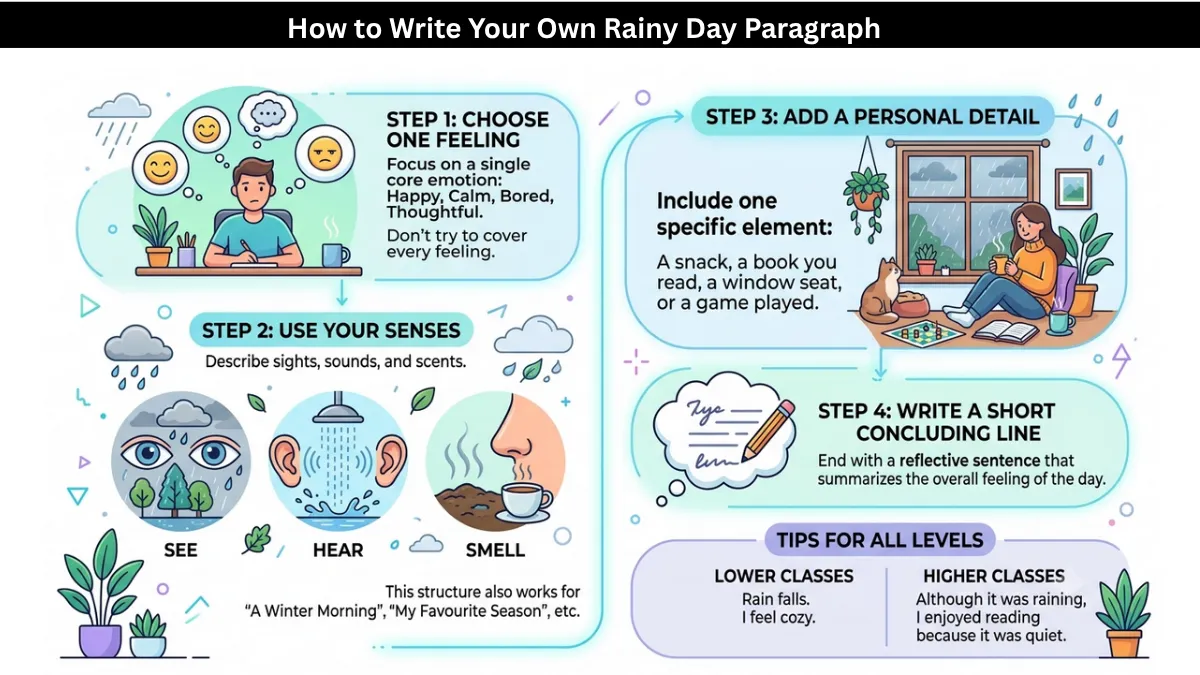
If you want to write an original version instead of copying one, follow this simple process:
- Start with one clear feeling – happy, calm, bored, or thoughtful. Do not try to cover every emotion at once.
- Use your senses – what did you hear (raindrops), smell (wet earth), or see (grey sky, wet leaves)?
- Add one small personal detail – a snack you had, a game you played, a window you sat by.
- End with a short concluding line- the line that reflects how the day made you feel.
- Keep sentences short for lower classes, and slightly longer with connecting words (“although,” “because”) for higher classes.
This structure works for almost any short descriptive paragraph topic, not just rainy days – the same steps apply to “A Winter Morning” or “My Favorite Season.”
Frequently Asked Questions
Q1. Are these paragraphs suitable for exams?
Yes. They follow a simple, student-friendly structure that English paragraph-writing exams typically expect.
Q2. Can Class 1 students write a 5-sentence version instead?
Absolutely - younger students of Class 1-2 can write short paragraphs within five simple sentences: waking up in the rain, the sound of rain, wearing a raincoat, watching from the window, the touch of raindrops on the fingers, and how it makes them feel.
Q3. What's the ideal word count for each class level?
Students of Class 1-2 can write roughly around 60-100 words, Class 3-5 can cover 100-120 words, and 130–160 words for Class 6–8. Going much longer is not necessary for this topic.
Q4. Can this paragraph be adapted into a 10-line essay?
Yes- break each sentence onto its own line. This format is often asked for in Class 1-3 English worksheets.
Q5. Is it okay to add local details, like the smell of wet soil or a specific street?
Yes, and it is encouraged. Personal, local details a favorite tea stall, a particular lane, a football game with friends) make the paragraph feel real, not copied.
Conclusion
A rainy day paragraph is one of the simplest yet most effective writing exercises for students across Class 1–8. Genuine observation and a clear emotional thread from start to finish do the real magic to make the writing truly genuine. Whether you’re a young student writing your first five sentences or an older student adding depth and reflection, the goal stays the same: describe what you noticed, and say how it made you feel.
Ready to Practice?
Pick the paragraph that matches your class level, read it aloud once, and then try writing your own version from memory- using your own rainy day experience instead. If you feel you can also explore a few more examples- “My Favorite Food”, “My Best Friend”, “Children’s Day”.
📖 Join 500+ parents & students
Daily essays, worksheets, and writing tips on Telegram.

I am not a professional writer. I do not have a degree in English literature. What I have is 10 years of watching children learn, a son in Class 4 who still asks me to help with his writing, and a genuine belief that every child has something worth saying- they just need the right guide.